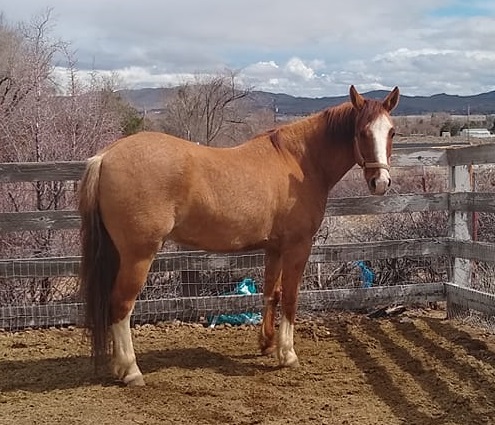
Another monthly update

Since the semester started I haven’t had as much time to work with Scout – I spend far more time picking up poop than actually handling my horses. If I get to ride more than once a week, I’m very lucky. So I wasn’t completely surprised that Scout has regressed with bridling. It took about ten minutes to get it on him yesterday, and I never got the brow band on – he kept spooking at that, so I had to take it off. I got the bit in his mouth once, and then he jumped back, forcing me to start over. At one point I was just going to quit and do more ground work, but I thought I’d give it one more try, and I’m actually glad I did.

I thought maybe he was concerned about the bridle because he didn’t like pressure on the bit, so I tried to ride him much more lightly. I don’t think I am hanging on the bit with that much pressure, but he’s very sensitive. For most of the ride last night, he was very good. He had a nice engaged trot that was easy to post to, he picked up the correct canter lead every time, and he usually went from a walk to a canter, which is unusual for him. He got a bit too excited in the canter the first time and threw his head around when I wanted him to slow down, but after that he was willing to transition back to a trot.

He has a tendency to want to break into a trot from a walk, and I usually use my seat to keep him walking. Basically, I follow his walk by rotating back and forth with his walking motion, and that seems to make it nearly impossible for him to break into a trot. I can use the same motion to ask him to transition from a trot to a walk. This motion is probably described best in Connected Riding by Peggy Cummings.

Scout has been playing hard to get also, again probably from not working with him as regularly. I’ve been trimming a number of other horses at the farm, so I wonder if horses get jealous. I expect to move him closer to home soon, so hopefully I will be able to get out more frequently to play with him.

He developed some lameness a couple of times in the last few weeks. The first time, he was much better after I trimmed him. The hoof wall on his right front foot had grown out much faster on the outside, and he was better after I trimmed him. He might need more frequent trims. Then the farm ran out of grass hay and was feeding him alfalfa, and he was lame again within a few days. I wasn’t certain it was the hay, but I bought some hay that was at least 90% grass, and in just a couple of days, he had improved, and after four days, I rode him with absolutely no lameness, not even the tripping he was doing during the summer. So from now on, NO alfalfa for Scout!

September update

I missed writing an update for August, so much has happened since July. Scout was having issues with his right leg, and I wasn’t sure if he was getting laminitis due to gaining weight or if the issue was higher in his leg. I changed the way I was trimming him, and that seems to have taken care of the issue. He went from tripping a few times a ride to only once or twice. I’ve also noticed that he has some trouble with his right stifle, but with exercise, I anticipate him being fine.

A low point a few weeks ago was Scout kicking the crap out of Miracle. I wasn’t there, but Cecelia told me she ran down from her house and grabbed a rake to scare him away from Miracle. They have been separated since then with Miracle pining for him, but now she is in a corral with an older gelding and not paying as much attention to Scout. In the meantime, Scout seems happy enough by himself.

In addition to riding him in the arena, I’ve taken him out in the field a couple of times, once almost all the way to the ride about half a mile away. He gets a little nervous away from the barn and was crashing through junipers trying to get back, but hopefully with more time, he will be more confident by himself. I’ve also been working with him on jumps, first on the lunge line and then trotting over a tiny cross rail. Today I trotted him over a cross rail about 10″ high and another that was probably a foot high. He seems uncertain when approaching and drifts back and forth, but he hasn’t refused one. He seems to like to do different things since when I gave him his head while trotting, he chose to trot over some poles.

His left canter lead is very solid, but he struggles with the right, possibly because of his stifle. He can pick up the canter lead, but it is a little rough – possibly cross firing. He has multiple paces at each gait. At the trot, he can do a slower gate that seems he’s pounding away or a trot at about the same pace but more lively. He can trot very fast, or he can just do a “trail ” trot (more controlled).

One thing he still needs work on is being able to walk to his rear while he is on a lead rope or longe line. He tends to swing away, and I follow him until he stops. Once he is more comfortable with that, I hope to try ground driving him again. He is calm enough that I think with some time, he will be able to pull a cart (and look awfully handsome while doing it).

Finally, he has made some progress with his ears. He lets me take off the bridle without taking it apart. I first started to hold it so he could take his right ear out himself. Then the right side will come off a moment later. He did this tonight with no signs of shyness. I even tossed the rein over his ears, and he didn’t seem to even notice. I don’t think I would be able to get a driving bridle on him, so I would probably just start with his regular bridle. I bought a nice used bridle that I’m anxious to try on him.

July Update

Much has happened since my last update a few weeks ago. Scout is getting easier to catch and often greets me at the gate. He has also come to me from across the arena when I’ve turned him out for some exercise. He seemed to be off in his front right leg, but if he is still off, it’s very difficult to tell. The biggest development since the last post is that I have ridden him several times.

I started out riding him with my Buena Vista saddle for a little more security. Although it was intended for gaited horses, his baroque build seemed to make it fit well. I would have kept using that except that I found the stirrups weren’t short enough for me to post, and I didn’t want to add more holes (though I probably will at some point). For the first ride, I just walked him, and then one or two rides later I jogged with him.

His top teeth seem to have sharp points, so I’ve been trying a sidepull with him, but he doesn’t seem to respond as well as with the bit. After his teeth are worked on tomorrow, I will compare the bit and sidepull again to see which I want to keep using.

Last Friday the wind was blowing pretty strongly, which seemed to make Scout a little nervous, but I decided to ride instead. I offhandedly told the trainer at the farm that I was a little afraid to canter him, and when I got on, I had trouble keeping him at a walk instead of a trot. For some reason, I decided to try a little cantering, which turned out to be a little rough at first. I think he was cross-cantering at the right lead, and when I turned around to try his left lead, he wanted to take off, forcing me to circle him to get him back to a trot and then a walk.

I’m not even sure why I decided to canter him except that I felt like my seat was solid, and with the wind, I was pretty sure it wouldn’t be hard to get him out of a trot. That was definitely true! I asked for a canter about four more times, and by the last time, he picked up a more relaxed canter for a few strides and then came back to a trot easily.

I have not been back on him since then simply because I’ve been busy with writing and trimming hooves (him and Miracle on Monday and then two other horses today). On the days I didn’t trim this week, I wanted to stay home to do more writing and class planning for the fall.

What’s a Whip?

One of the most frustrating things with Scout is that he either doesn’t understand what the whip is for, or he is completely desensitized to it (I keep wondering if he was beaten with one at some time). When I got him, he had only been longed loose in a round pen, and although I thought he learned how to longe on a line quickly, I soon realize that it was out of fear. If we stopped and I wanted him to start again, it was next to impossible because he wanted to stay close and didn’t respond in any way to a whip.

After several sessions, sometimes just tapping for a dozen or more times before getting a response from the whip, he is starting to get the idea, but it always seems like the proverbial three steps forward, two steps back. Once he does learn something, though, it seems permanent. Although he is still quite ear-shy, I can always at least touch his ears as long as I don’t try to rub them. He might move away at first, but once he lets down his guard, he will drop his head so that his ear makes contact with my hand, and he will leave it there as long as I don’t move my hand.

From no contact to this!

As you can see from his photo, his eye is not wild, and by the end of a training session, he looks like he’s ready to fall asleep. I’m not sure he is entirely relaxed, though, and I sometimes suspect he has some “learned helplessness.” He is reluctant to try anything new, perhaps out of fear. Maybe it isn’t even something that he developed but is a protective strategy. He’s not a new gather, by any means, though. He was gathered (a euphemism for captured) as a yearling and adopted out within a few months – he is eight now. This experience is just as much about me learning about mustangs as it is for Scout to learn how to adapt. Although he has lived in a domestic setting for about seven years, he has not been handled as much and was ridden only four months. I’m anxious to get on him to see how he does, but I also want to make sure it is a positive experience and that he is ready for it.

Back Home after Two Weeks

After getting to some appointments at the VA and picking up the dogs from Dayton, I stopped by the farm to see the horses. Scout let me put his halter on relatively quickly, maybe five or ten minutes. He also seemed to remember the work I had been doing with his ears and head, not spooking very much when I rubbed the base of his ears. On the next day, however, he and Miracle had been moved to a shared pen, and he was worse than he has been for a long time about being caught. I don’t know if it was because someone else caught him earlier in the day or maybe because it was a new pen.

I worked with him for about 15 minutes while Miracle was standing tied (I was finishing a trim on her), and I didn’t get very far. After I finished Miracle’s hooves, I took her to the round pen and went back to try to catch Scout. I came closer, but he still wouldn’t let me put the rope anywhere near him. I could rub him all over, but as soon as I lifted the leadrope, it was over! Before my third try, I got some treats out of the horse trailer, and he let me put the halter on next to the gate.

I hadn’t prepared to work with him, so I didn’t have any long lines, but I longed him in small circles with just the leadrope. I focused on touching him with the whip to signal him to go forward instead of him running away from it. I also worked on voice commands – walk on, trot, and ho. The whoa seems to be the most challenging for him to figure out. I also had him stand in front of me and signaled for him to go by by swinging the whip next to his back him, and he did this better than before. I also had him do turns on the forehead and hindquarters, which were also good, but sidepassing was harder for him to figure out or to do. The last thing I did was to stand next to him on a step stool and put pressure on his sides as if I might get on him. I also leaned over his back, which I didn’t think he would have a problem with (and he didn’t).

Putting on the Bridle

Second time with the bridle on – I know the throat latch should be threaded the browband, but I didn’t want to push things.

I actually started to bridle Scout before I left for nearly two weeks, but I thought it warranted its own post. I knew I had to take the bridle apart before putting it on him, but I should have taken some of the parts off. After getting the bit in his mouth and gently placing the headstall over his poll, the browband got stuck between his ears, and he went nuts. He kicked the grooming caddy and tossed brushes all over, and I ended up with a rope burn just below my elbow on the inside of my arm (see photos below). I managed to get it unbuckled and off of him. I tried again with just the crownpiece and cheekpieces (English bridle) and was successful on this try.

The aftermath of the first attempt at bridling Scout.
First time with bridle on.

I put the bridle on again a couple of days later, and after getting the crownpiece and cheekpieces on, I rubbed his head with the browband and got him used to feeling it go across his forehead. Then I unbuckled the cheekpiece on the right side and slid the browband on. I then gently placed it across his forehead and attached it to the left side the same way as the right (see the photo at the top). The only part of the headstall to add now is the cavesson.

Attempting to use the bit while longing or trying to get him to drive was another story. He seemed nervous with any pressure on the bit, so the second time I worked him with the bride, I didn’t bother to attach any lines to the bit and just attached them to the halter.

First Steps

Getting Scout fulfilled multiple desires for me: to have a companion for my mare, to finally have my own mustang, and to have a younger horse. The previous owner told me that he had 120 days under saddle but that it had been at least two years before since her husband had been going through treatment out of town for cancer. She said Scout had two main issues – he was so ear-shy, the bridle had to be taken apart to put on him, and a rider had to get on quickly or he would scoot out from under him or her. She said Scout never bucked under saddle, though.

I had experience with an ear-shy horse before and with mounting issues, so I thought I could tackle these things. I also decided to start working with him as if he had no saddle training, starting with ground work like long-lining. The first step, though, was catching him. I kept a halter on him for the first three weeks, and he gradually became easier to catch. He always seemed fearful, though, not just of someone touching his ears or sides. He did seem to learn quickly. He had only been worked in a round pen and not a longe line, but without a round pen, I had to get him to longe. The first day I worked on this, we didn’t get far, but the second day, he seemed to longe like an experienced horse. Unfortunately, it was more of a fear response.

I quickly realized that he needed de-sensitizing all over – his ears, his head, his sides. I sacked him out with a light blanket and tossed ropes over him and against his legs. However, he wouldn’t move ahead of me, so ground driving wasn’t possible. He also didn’t respond to a whip. I began to think that he had developed “learned helplessness” and was afraid to try anything unfamiliar.

I continued to work with his ears, sometimes with clicker training and sometimes just repetition. He would flinch if I moved my hand toward his head, so I began to think he was head-shy as well as ear-shy. I continued to rub around his eyes gently with my hands and was finally able to rub the top of his head between his ears and touch the base of his ears. He was worse on the right side, but he appeared to have a fungus or plague in that ear. I also found that it was easier to handle his head if I was not reaching up toward him. It seemed that perhaps someone had also “eared” him at some point, meaning to grab the horse’s ear and to pull down in order to control him.

One morning while trying to catch him, the barn owner helped me with join-up. I was familiar with the concept but not the details on how to use it. Liz had me back up if Scout turned toward me, and she had me watch for his ear to turn toward me in order to anticipate when he might come toward me. When he did come towards the center of the circle, I was to back up to release the pressure and even turn around. She had me watch for signs of relaxation – dropping his head, licking his lips. The first time took about 20-30 minutes, and the second time a little shorter.

By the time I had to go out of town for about two weeks, this is where we were. He would longe relatively well, and he had gotten to the point that he didn’t panic when a rope slid over his rump and against his legs. He wasn’t driving yet, and he wasn’t responding to a whip. And he was getting a little easier to catch without treats (food always helps to catch him, but I don’t like to rely on that method). One day he was so calm that if I had already put a saddle and bridle on him, I might have mounted him in the round pen. I did not have another chance before I left.

Acquiring Scout

I picked up Scout on April 1, and I’m not sure if that will ultimately be meaningful. I found the ad for him on Craigslist where he was advertised for free as a companion horse with photos of a horse that seemed to have a kind face. If I remember correctly – much has happened since then – the ad mentioned that he was ear-shy and that his sides were sensitive. After corresponding several times with the owner and thinking that surely someone would pick him up before I had a chance to (the owner was giving him away to the first person who showed up), I headed out on the four hour drive with my horse trailer in two.

The only thing that was disappointing when I saw him was that he was pigeon-toed, but this does not seem to be uncommon in mustangs. He was shy, but the owner said it just takes time for mustangs to warm up to new people. Once she put my halter on him, she took him in the round pen for a few minutes while the brand inspector took care of paperwork, and then she hustled him into my trailer before I had a chance to say whether or not I was actually taking him. Before I left, I asked if she wanted to get updates about him, and she said no, that it was like moving out of a house – one needs a clean break. She did text the next morning to make sure we got home safely. I wasn’t sure how well he would unload, but he was fine.

I left the halter on him since I wasn’t sure I would be able to catch him, and that was probably a good idea. Ultimately (long story), I ended up moving him to a place with a smaller pen and took the halter off then. It didn’t take long for him to accept treats from me, though.

Since I didn’t buy Scout, an eight-year-old mustang, “acquiring” seems like the most appropriate term. He had been gathered as a yearling, so he wasn’t directly off the range and had some saddle training. His name was actually Tang, partly for the orange tint to his coat and partly for “mustang.” Since he seemed fearful and nervous, I wanted to give him a name that reflected curiosity and courage but when I was drawing a blank, I turned to the Facebook “hive mind.” One of the suggestions was Brave, but I’ve already had a gelding by that name. My favorite of the suggestions was Scout, which seemed a perfect choice for a mustang.

Since he hadn’t been worked much for a couple of years, I decided to start working with him as if he hadn’t been mounted yet. Watch this space for more updates about Scout’s progress.