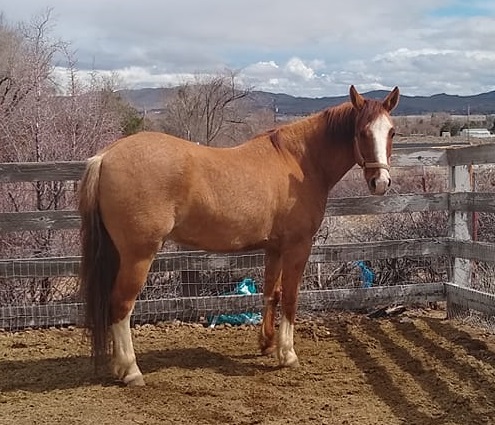
Getting Scout fulfilled multiple desires for me: to have a companion for my mare, to finally have my own mustang, and to have a younger horse. The previous owner told me that he had 120 days under saddle but that it had been at least two years before since her husband had been going through treatment out of town for cancer. She said Scout had two main issues – he was so ear-shy, the bridle had to be taken apart to put on him, and a rider had to get on quickly or he would scoot out from under him or her. She said Scout never bucked under saddle, though.
I had experience with an ear-shy horse before and with mounting issues, so I thought I could tackle these things. I also decided to start working with him as if he had no saddle training, starting with ground work like long-lining. The first step, though, was catching him. I kept a halter on him for the first three weeks, and he gradually became easier to catch. He always seemed fearful, though, not just of someone touching his ears or sides. He did seem to learn quickly. He had only been worked in a round pen and not a longe line, but without a round pen, I had to get him to longe. The first day I worked on this, we didn’t get far, but the second day, he seemed to longe like an experienced horse. Unfortunately, it was more of a fear response.
I quickly realized that he needed de-sensitizing all over – his ears, his head, his sides. I sacked him out with a light blanket and tossed ropes over him and against his legs. However, he wouldn’t move ahead of me, so ground driving wasn’t possible. He also didn’t respond to a whip. I began to think that he had developed “learned helplessness” and was afraid to try anything unfamiliar.
I continued to work with his ears, sometimes with clicker training and sometimes just repetition. He would flinch if I moved my hand toward his head, so I began to think he was head-shy as well as ear-shy. I continued to rub around his eyes gently with my hands and was finally able to rub the top of his head between his ears and touch the base of his ears. He was worse on the right side, but he appeared to have a fungus or plague in that ear. I also found that it was easier to handle his head if I was not reaching up toward him. It seemed that perhaps someone had also “eared” him at some point, meaning to grab the horse’s ear and to pull down in order to control him.
One morning while trying to catch him, the barn owner helped me with join-up. I was familiar with the concept but not the details on how to use it. Liz had me back up if Scout turned toward me, and she had me watch for his ear to turn toward me in order to anticipate when he might come toward me. When he did come towards the center of the circle, I was to back up to release the pressure and even turn around. She had me watch for signs of relaxation – dropping his head, licking his lips. The first time took about 20-30 minutes, and the second time a little shorter.
By the time I had to go out of town for about two weeks, this is where we were. He would longe relatively well, and he had gotten to the point that he didn’t panic when a rope slid over his rump and against his legs. He wasn’t driving yet, and he wasn’t responding to a whip. And he was getting a little easier to catch without treats (food always helps to catch him, but I don’t like to rely on that method). One day he was so calm that if I had already put a saddle and bridle on him, I might have mounted him in the round pen. I did not have another chance before I left.
 Sojourns with Scout